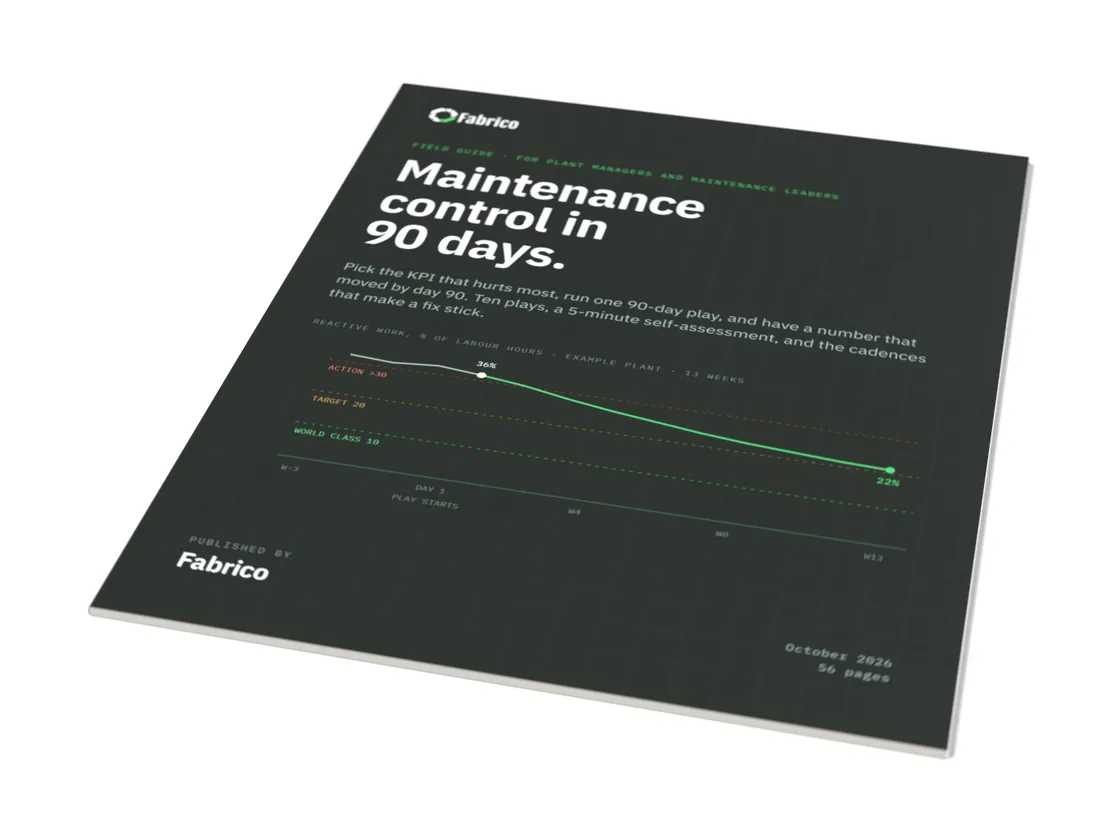
Get maintenance work under control in 90 days. Without buying another dashboard.
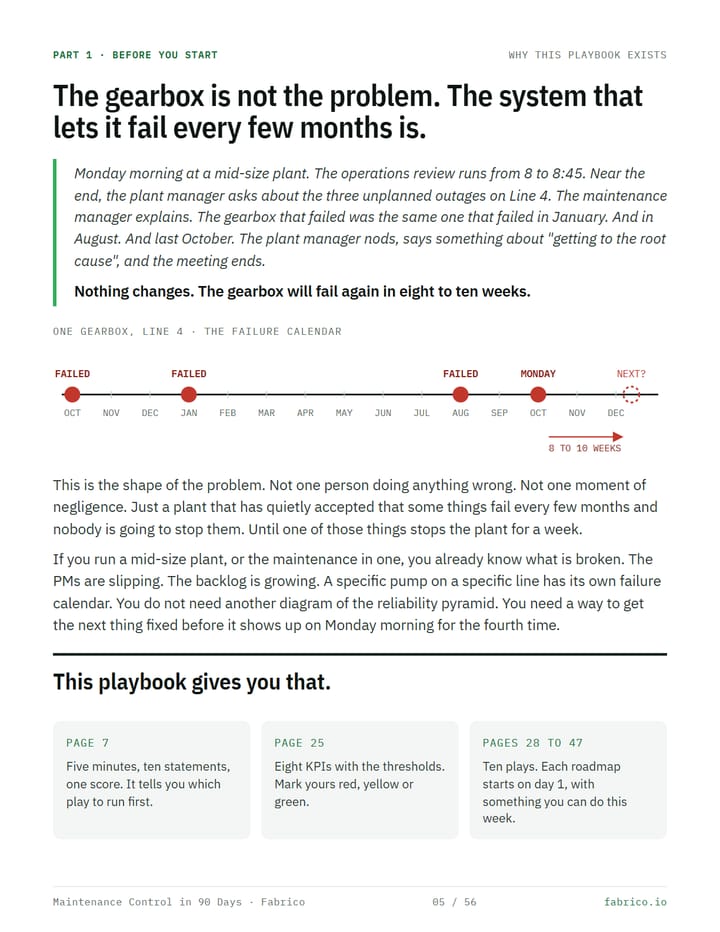
The same gearbox fails every eight to ten weeks, and the Monday meeting lets it. This field guide shows you how to stop it. Take a 5-minute check to find your weakest number, then run one 90-day play to move it.
10 plays, each with a 90-day roadmap8 KPIs with sourced targets1 check-in that tells you where to start
One play, one number you can prove, and 90 days to move it
90days per play
Every roadmap starts on day 1, not next quarter. Days 1 to 3 are always something you can do this week.
1number per play
Each play moves one KPI, with one owner and one Monday review. Start with your two lowest statements; the guide says three plays at once is hard (page 51).
8sourced targets
The targets follow the SMRP Best Practices metrics named on each play. The action and world-class bands are working bands from practice, and the guide marks them as such.
5minutes to score
Ten statements on page 7. Your two lowest point to the plays you start with.
Who this is for. And who should close the tab.
For
Maintenance managers and reliability engineers in plants of roughly 50 to 2,000 people, with a CMMS that is only half used.
Plant managers and operations directors who sign the maintenance budget and get the Monday question about Line 4.
Anyone who has watched the same asset fail three times and wants the fourth time not to happen.
Not for
A plant looking for a tool to buy instead of a way of working. The tool comes last in this guide, on purpose.
A reader who wants theory. Better books exist for that; page 53 lists them.
Level 5 plants. If you are one, we would like to hear what you do differently.
What is inside
Five parts. Read page 7 first, then the two plays it points you to.
Part 1 · Before you start
Why this playbook exists5
What this is, what it is not, how to use it6
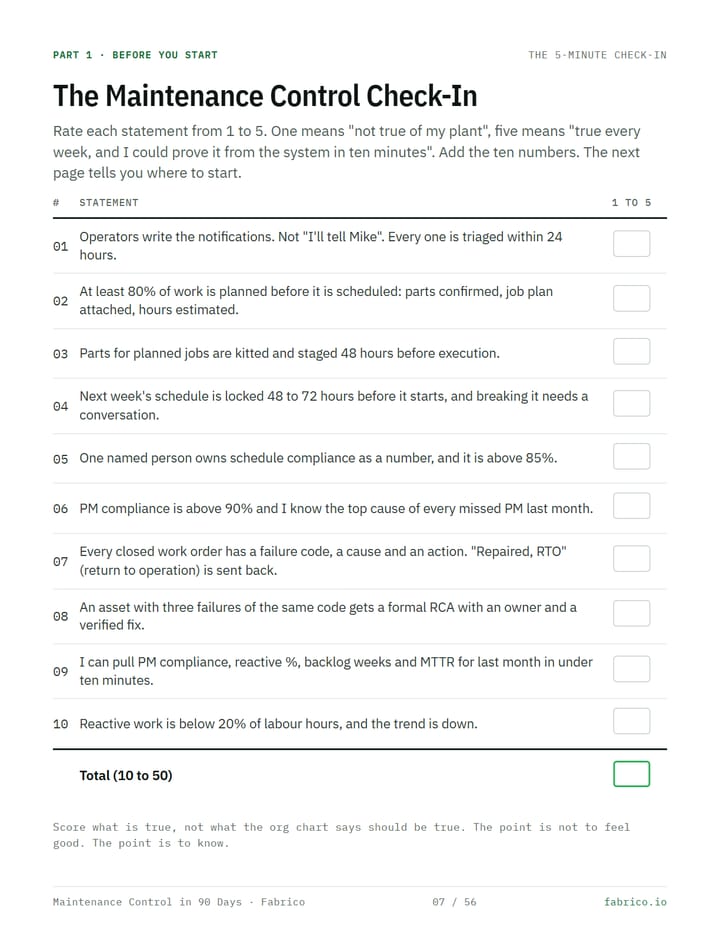
The 5-minute Maintenance Control Check-In7
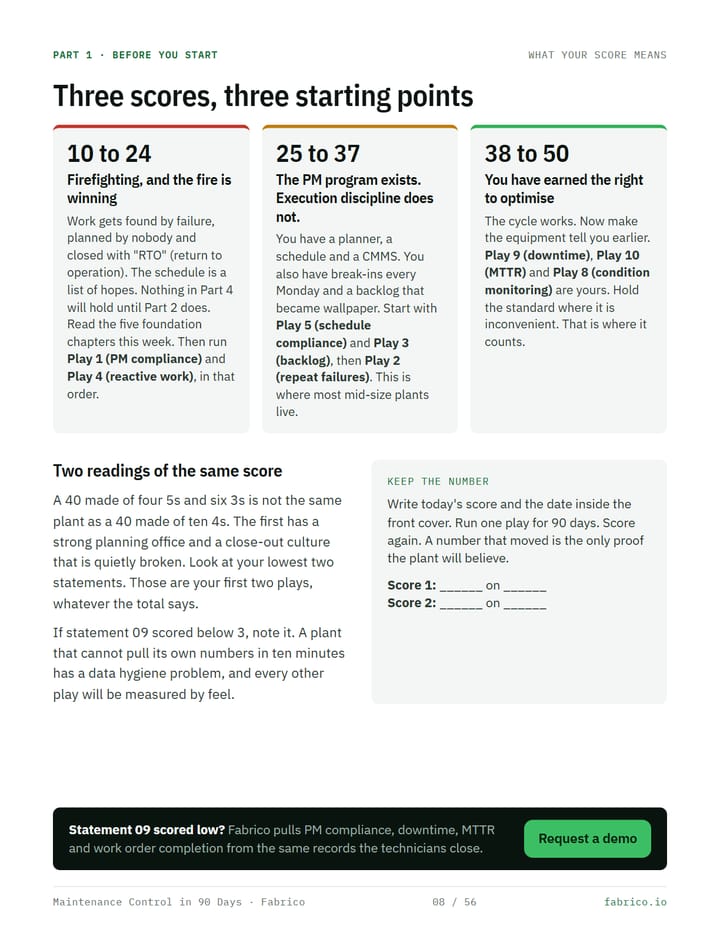
What your score means, and where to start8
Part 2 · Foundations
Why foundations matter: the work cycle10
Work identification11
Planning, and the ready-to-schedule gate13
Scheduling15
Work execution17
Close-out and the feedback loop19
Part 3 · Where are you
The maturity model22
The self-assessment23
The benchmark snapshot25
Where the numbers come from26
Part 4 · The ten playbooks
1 · PM compliance recovery28
2 · Repeat failure investigation30
3 · Backlog growth control32
4 · Reactive work reduction34
5 · Schedule compliance improvement36
6 · Inspection compliance recovery38
7 · Spare parts management40
8 · Condition-based monitoring42
9 · Downtime reduction44
10 · Asset reliability and MTTR46
Part 5 · Tools and cadences
RCA quick guide49
The 90-day implementation cadence51
References53
Where Fabrico fits54
What happens in the 30 minutes55
p. 7
The 5-minute Maintenance Control Check-In. Ten statements, one score, and the two plays that match it. You find your first play before page 9.
p. 14
The ready-to-schedule gate. Five items. If any is missing, the work order stays in planning, and the most common reason a schedule breaks, a job released without parts, goes away.
p. 19
"Repaired. RTO." is not data. It is a receipt. The three close-out fields that turn a CMMS into a plant that learns.
p. 25
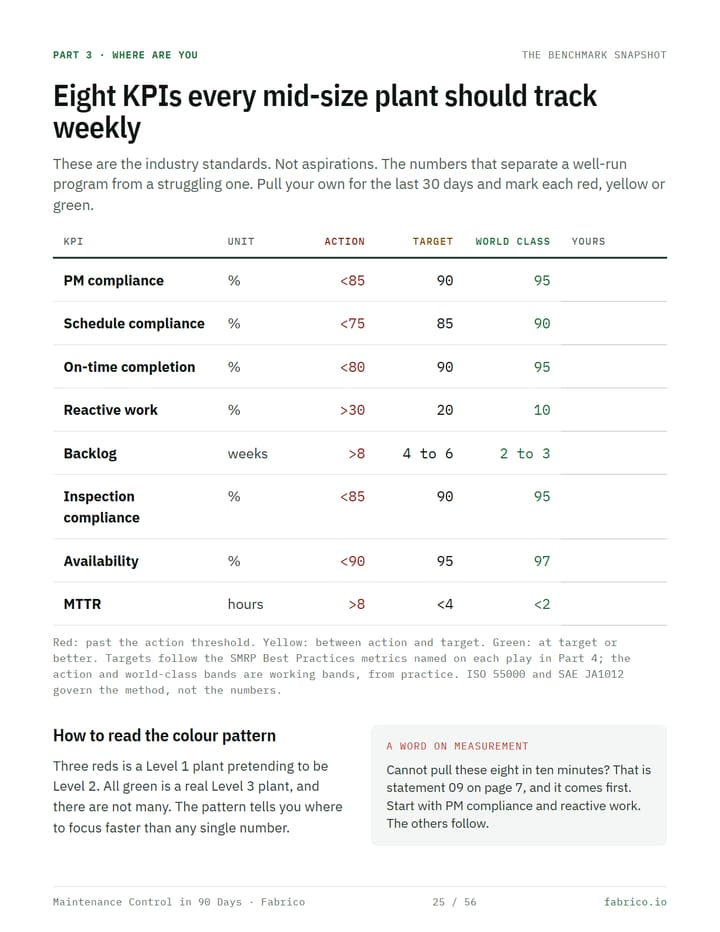
The benchmark table. Eight KPIs with action, target and world-class thresholds. Pull your last 30 days and mark them red, yellow, green.
pp. 28 to 47
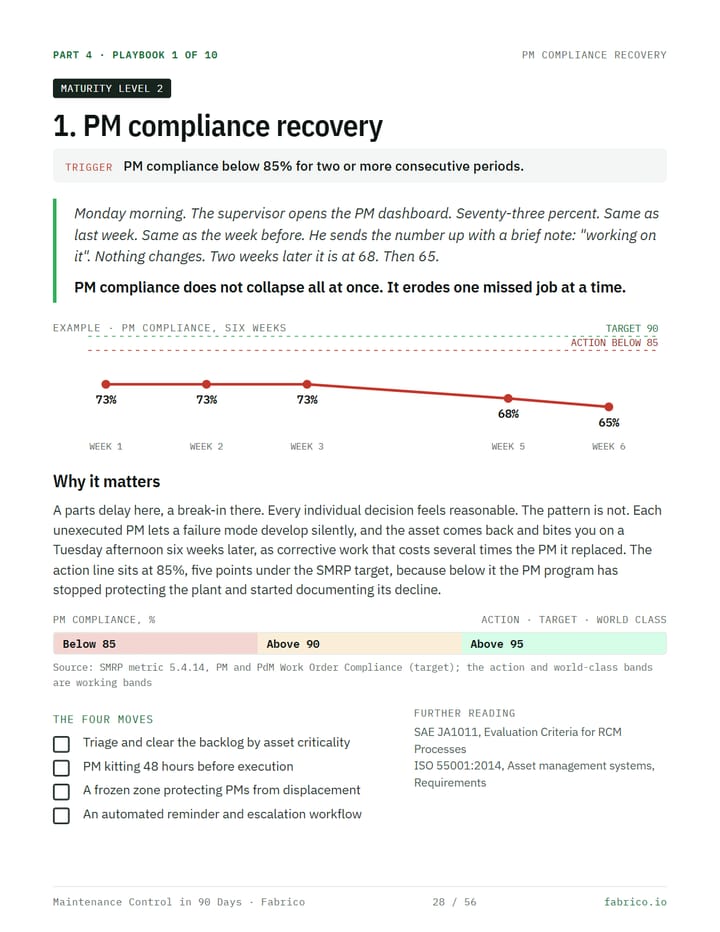
Ten plays. Pick the one that matches your worst number. Each with a trigger, a 90-day roadmap and the four moves that hold it.
each play
How each play runs in Fabrico, on real screens. Sample data, the actual product. Page 43 says plainly what Fabrico does not do.
Look inside: eight pages
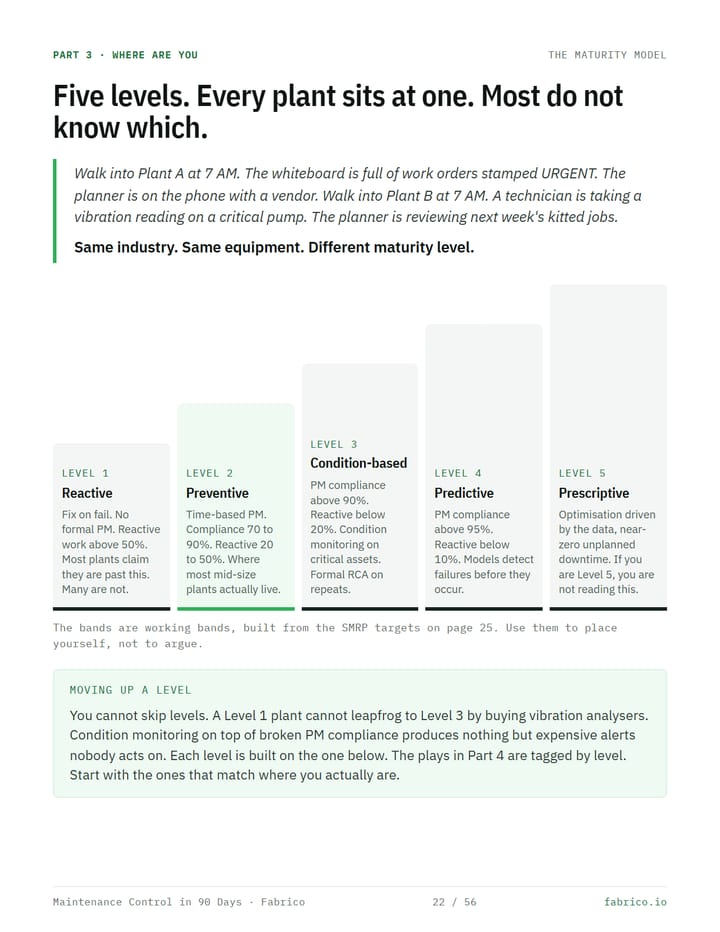
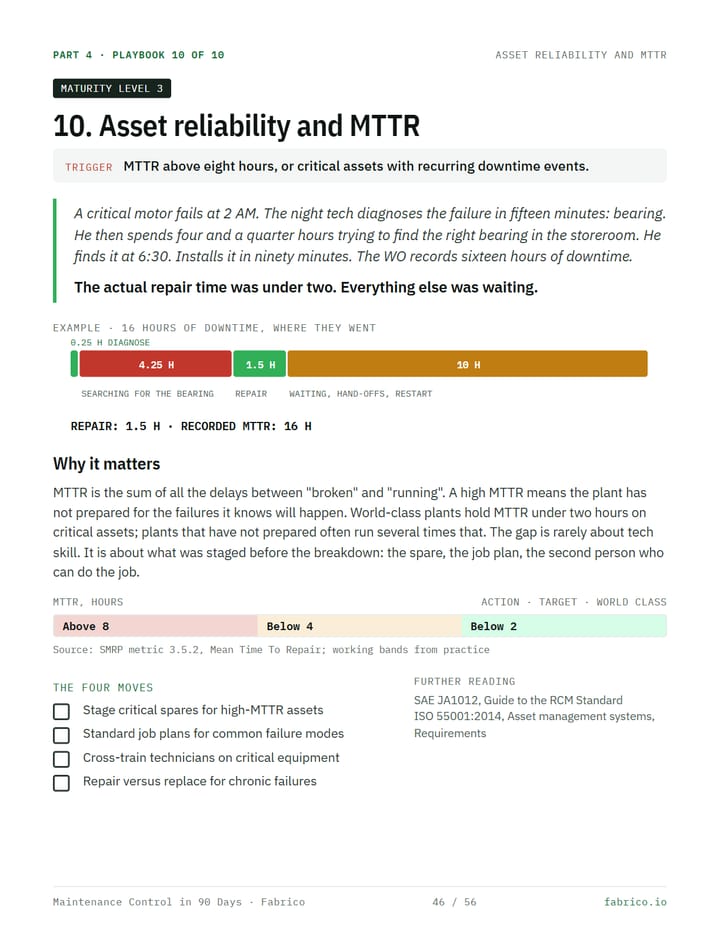
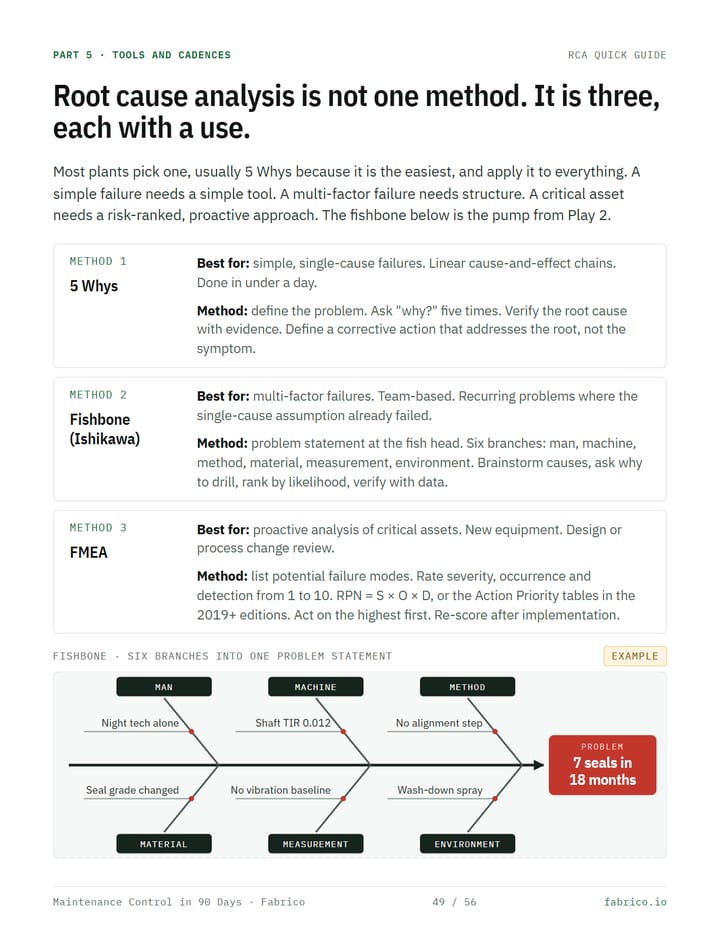
Page 5 · One gearbox, four failures. The next one has a date.Page 7 · The Maintenance Control Check-InPage 8 · Three scores, three starting pointsPage 22 · Five maturity levels, and why you cannot skip onePage 25 · Eight KPIs: action, target, world classPage 28 · Play 1, PM compliance recoveryPage 46 · Sixteen hours of downtime, ninety minutes of repairPage 49 · Root cause analysis: 5 Whys, fishbone, FMEA
The 5-minute check-in, live
Score your plant before you read a page
The ten statements from page 7 of the guide. Rate each from 1 to 5: one means "not true of my plant", five means "true every week, and I could prove it from the system in ten minutes". Your running score shows as you go; your first two plays appear when all ten are rated. No e-mail needed.
0 / 500 of 10 answered
Statement1 not true of my plant · 5 true every week, provable
The digital edition is free
Get the guide
The whole guide as a PDF, for screen and print. The download opens here the moment you send the form.
p. 7Start here: the check-in, five minutes.
p. 25Pull your last 30 days into the benchmark table.
p. 51Run your first two plays, two at a time.
Digital edition
Free
Questions a sceptical plant manager asks
Why is the digital edition free?
We make money when a plant decides to run these plays in Fabrico. Most readers will run them on paper and the CMMS they already own, and that is fine: a plant that gets its maintenance under control is a better customer later, or a better plant, full stop. So we give the method away and show the screens.
Is this a sales pitch with a guide wrapped around it?
No. The method fills the guide. Each play has a short box showing how it runs in Fabrico, on real screens with sample data, and the last three pages are about Fabrico. Page 43 says plainly what Fabrico does not do, and page 55 tells you minute by minute what a demo contains, so you can skip it.
Do I need Fabrico to use the plays?
No. Every play works on paper and in any CMMS, slower. The guide says so on page 6. The Fabrico boxes show what the plays look like when one system holds the work.
Does it work if we run SAP PM?
Yes. The plays work in any CMMS, SAP PM included. If you run them in Fabrico, Fabrico syncs both ways with SAP PM and connects to SAP S/4HANA, so your planners keep their SAP records.
Is it available in my language?
The guide is in English. The Fabrico interface runs in English, German, French, Polish and Bulgarian.
Can I share it with my team?
Yes. Send them this page so they get their own copy. The check-in on page 7 works best when the plant manager and the maintenance manager score it separately and compare.
What happens after I send the form?
The download opens on this page straight away. Fabrico stores your name, e-mail, company and check-in answers, sends you the guide and up to four e-mails about it, and a Fabrico consultant may follow up. Every e-mail has a one-click unsubscribe.
Which plants is it written for?
Mid-size discrete and process plants, roughly 50 to 2,000 people, with a maintenance team, a PM program that exists on paper and a CMMS that is half used. If your reactive work is above 50 percent, start with Part 2 and Play 1. If you are a Level 5 plant, you are not the reader.
When the play needs a system
Sixteen hours of downtime. Ninety minutes of repair.
The guide's own example, page 46. Already know your number? Bring the KPI that hurts most to a 30-minute demo with a Fabrico consultant and see the play run on one platform: OEE and MES, with the CMMS built in.